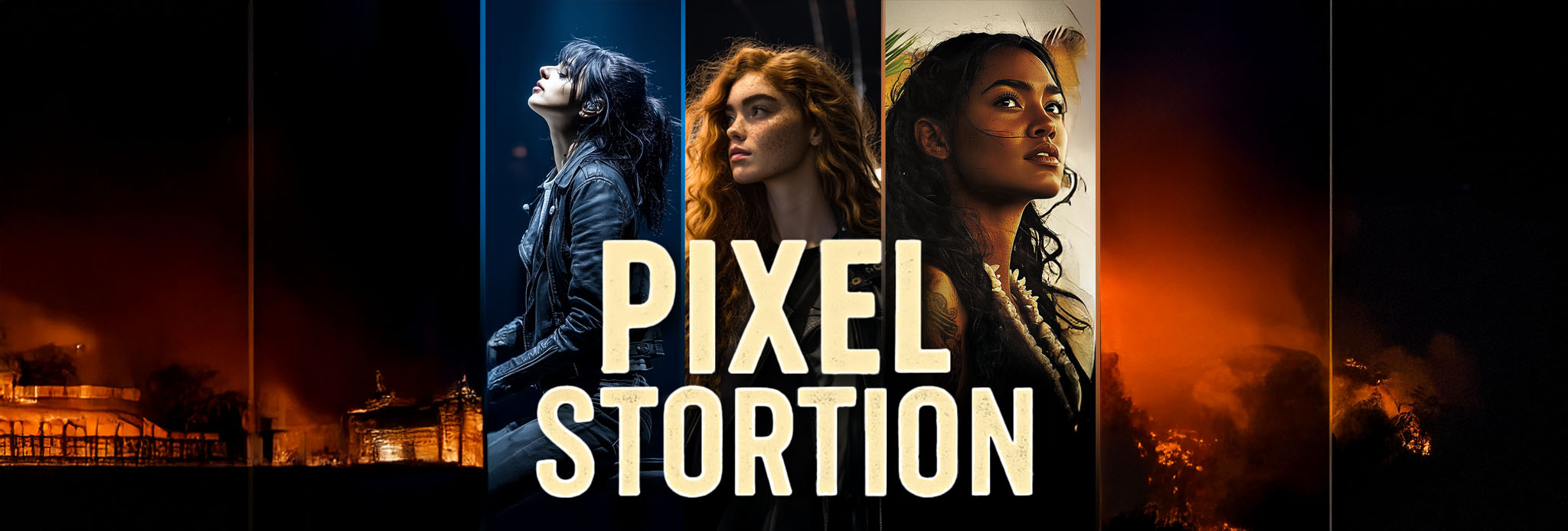
I wanted to write characters who make perfect sense if you listen, but no sense if you try to categorise them using shortcuts.
Ethel is quiet, measured, and direct. People read that as cold. It isn't. She inherited her father's steel but none of his darkness, and her grandmother's intellect. She was stuck inside Dominic's world with no safe way out, so she did what she was built for. She mapped it, documented it, and built a case from the inside.
Isla is chaos with purpose. Intuitive, creative, unnervingly insightful, and loud about it. She turns what happened to her into sound. Not because she planned a career out of it. Because she couldn't not.
Dominic speaks in the measured, calm cadence of a man who genuinely believes that order is something only he can enforce. He makes perfect sense on paper. That's the problem.
Where AI gets it wrong
I use AI. I'm an animator. I've made short films and I know how long they take. I can make a three-minute film by myself but not a two-hour feature. And I want to make a feature.
So AI is a production tool — not to write the story, but to build something too large to build alone.
But here's the thing. AI is trained on normative data. These characters are not normative. The hero's journey is the story of someone different, otherwise we'd all be heroes.
I have had AI call Ethel a sociopath. A villain. An ice queen. An "autistic robot," which is a layered insult all on its own. This is in spite of her being the moral backbone of the story.
AI looks at her and sees a cliché, a trope, and a category.
This happens because of something called regression to the mean. AI algorithms prioritise the average, the data density, as a proxy for truth. When it encounters an outlier like Ethel, it pulls her toward the centre. Treats her moral nuance as noise. Smooths it away.
Every point in that sparse space isn't an error to be corrected. It's a person.
What Isla does with it
Isla sings about a suicide that never happened, told in past tense like it did. Emotional sleight of hand. She sings about what survival actually feels like, not the movie version, but the quiet kind that reshapes thought, trust, and belonging.
AI would flatten this into a "trauma recovery anthem." It would miss the sleight of hand entirely.
The scary part
To me, what AI does horribly is scarier than what it does well.
Imagine lazily handing surveillance to AI, only to have it flag all the outliers as "potential problems" because it forces them into a box. These people are often our early awareness mechanisms. We need them.
Imagine 1940s Germany with AI. We look back at the Nuremberg defence and think we live in a better society. But the people who played along then are the ones playing along in the lesser-stakes games of the present.
And nobody wants to meet the person they should be but weren't, couldn't, or don't know how to be.
The compost
If it's only about the AI and nothing else, then it probably warrants the slop label. But slop can be compost. It can't grow something of worth by itself, but fighting it — yelling at it until it gives you something interesting — can be very insightful.
Slop is compost. You just have to fight it to grow something real.
AI isn't going to write a unique story for you. Not yet. It won't understand Ethel or Isla. Left alone, it will destroy all the complex nuance.
A story that has these characters is not a story written by AI. Sure, AI can help with the structure, the planning, the dates and times and things that are not the story. But it can't write the story about complex human characters for you.
This is what directors do. This is what writers do.
And this is what I'm trying to do.